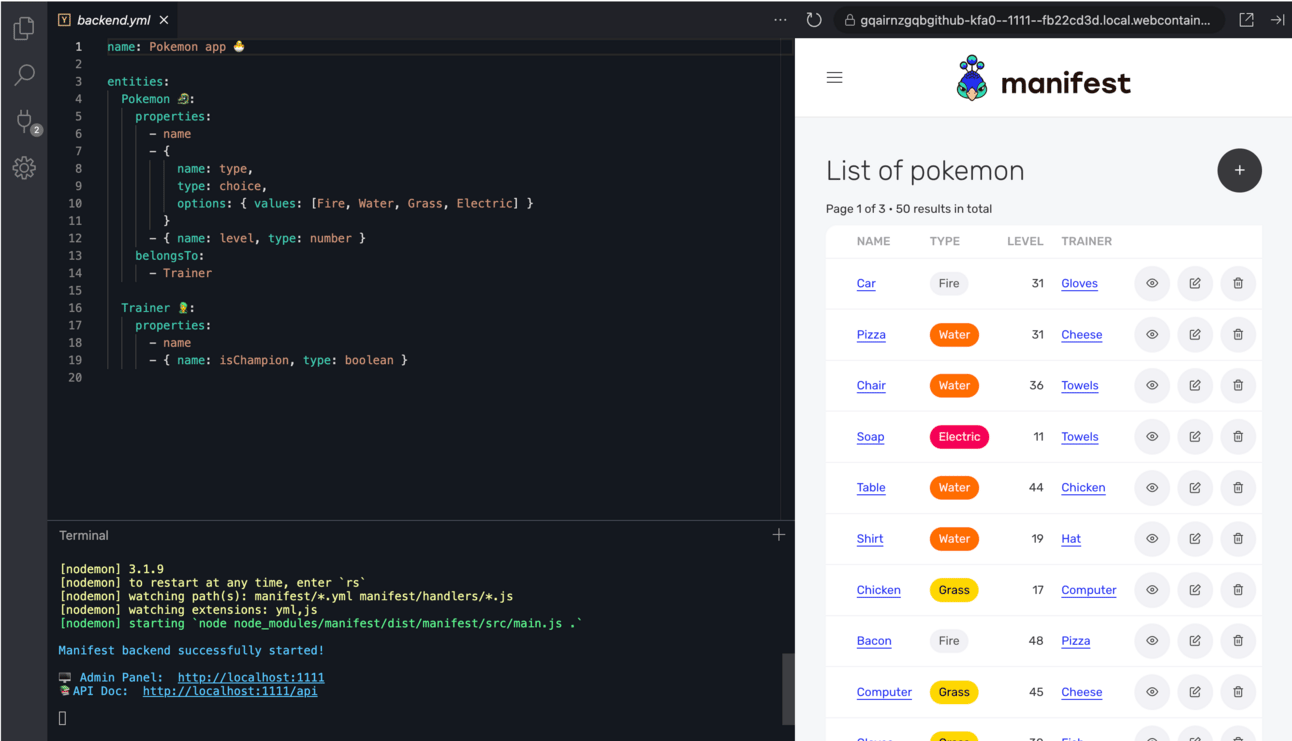
Ever wished you could skip all the backend boilerplate and just describe what you want? Manifest lets you do exactly that. Your entire backend - DB, APIs, storage, auth - lives in one YAML file.
What is Manifest?
Manifest is a tool that enables developers to define microservices, APIs, databases, storage, and authentication through a single YAML configuration file. It eliminates repetitive setup and backend code requirements.
The Manifest team, an independent group focused on simplifying backend development, built and maintains this open-source platform.
Key Features
- YAML-Based Configuration: Your entire backend lives in one YAML file. Database schema, API endpoints, storage, auth - all defined declaratively.
- Minimal Boilerplate: No more copying and pasting standard backend scaffolding. Define what you need and Manifest generates the rest.
- Auto-Generated APIs: Creates frontend-ready endpoints without additional integration work. Your frontend team can start building immediately.
- Integrated Authentication: Built-in user auth requires no extra libraries or setup. Just define your user model and you're good to go.
- Automatic Admin Panel: Generates a complete administrative interface for data management out of the box.
What Else Can It Do?
Beyond the core features, Manifest also handles:
- A playground for experimentation and rapid prototyping
- Database and file storage management
- Headless application architecture
- Microservices like payments and notifications
- CRUD-intensive applications such as product databases, directories, and mobile app backends
How Mature Is It?
Manifest sits at a medium maturity level. It's well-suited for prototyping, internal tools, and early-stage products. For production-grade applications with complex business logic, you'll likely outgrow it. But for getting an MVP off the ground fast, it's hard to beat.
How It Compares
If you're evaluating backend tools, here's how Manifest stacks up against the alternatives:
- Firebase - Google's Backend-as-a-Service with realtime database. More mature but vendor-locked.
- Supabase - Open-source Firebase alternative built on PostgreSQL. Great for SQL-first teams.
- Xano - API-first no-code backend builder. More visual, less developer-oriented.
- Appwrite - Open-source backend server for web and mobile. More features but more setup.
Manifest's sweet spot is simplicity. If you want the fastest path from zero to working backend, it's worth trying.
When Should You Use It?
Manifest is a great fit when you're:
- Building an MVP and need a backend in hours, not days
- Prototyping a side project over a weekend
- Setting up internal tools for your team
- Building CRUD-heavy applications (directories, catalogs, dashboards)
- Working on a mobile app that needs a simple API backend
For complex business logic, real-time features, or enterprise-scale applications, you'll want something more robust. But for everything else, just YAML it.
Bottom Line
For MVPs, side projects, and internal tools, Manifest is a compelling option. It won't replace your production backend, but it'll get you to a working product faster than almost anything else. And in the startup world, speed wins.